Evaluating the 3D Flower Stand SVG Bundle for Laser Cutting and DIY Decor
For creators working with laser cutters or digital cutting machines, finding assets that bridge the gap between flat design and tangible, three-dimensional objects is often a challenge. The 3D Flower Stand SVG Bundle addresses this specific need by providing a collection of layered floral designs engineered for assembly. Unlike standard silhouette files that result in single-layer decals, these designs utilize interlocking tabs and layered petals to create freestanding botanical displays. This article examines the practical utility, file compatibility, and material considerations of this bundle to help you determine if it aligns with your current workflow or upcoming project requirements.
Design Architecture and Structural Integrity
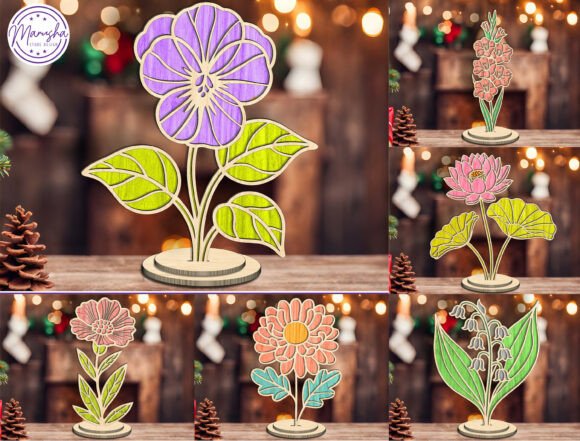
The core value of any 3D laser-cut project lies in its engineering. A design may look appealing on screen, but if the tolerances are incorrect, the physical assembly will be frustrating or structurally unsound. The six unique designs included in this bundle—Morning Glory, Lotus, Gladiolus, Zinnia, Daisy, and Lily of the Valley—demonstrate a clear understanding of how different materials behave under stress and during assembly.
Each flower features distinct layering strategies. For instance, the Lotus and Lily of the Valley designs rely on curved petal arrangements that require precise slotting to maintain their shape without adhesive. The Gladiolus and Zinnia models use tighter, more complex layering to mimic the density of real blooms. From a technical perspective, the vector paths are clean and closed, which is critical for preventing laser head errors during cutting. The inclusion of registration marks or alignment guides, where applicable, simplifies the stacking process, ensuring that the final product looks professional rather than handmade in a rushed manner.
Software Compatibility and File Versatility
One of the most significant strengths of this bundle is its format diversity. It includes SVG, AI, EPS, PDF, DXF, and DWG files. This broad compatibility ensures that users are not locked into a specific software ecosystem. Whether you are using LightBurn for an OmTech or xTool machine, Glowforge’s proprietary interface, or design software like Adobe Illustrator and CorelDRAW, the files are ready to import without extensive conversion.
- SVG and DXF: Ideal for direct import into most laser control software and Cricut Design Space.
- AI and EPS: Best for designers who need to edit anchor points or adjust dimensions before cutting.
- PDF and DWG: Useful for archival purposes or integration into CAD workflows for architectural or large-scale display planning.
This flexibility reduces preprocessing time. For small business owners who need to iterate quickly on client proofs, having access to editable vector formats means you can resize a Daisy for a tabletop centerpiece or scale up a Lotus for a larger garden installation without losing path integrity.
Material Considerations and Fabrication Tips
The bundle recommends using 3mm–6mm plywood, MDF, or acrylic. These material choices are standard for laser cutting, but the thickness selection significantly impacts the final aesthetic and stability. Thinner materials (3mm) allow for more delicate, intricate details, making them suitable for the finer petals of the Morning Glory. However, they may require additional support or careful handling during assembly. Thicker materials (5mm–6mm) provide greater structural rigidity, which is beneficial for larger flowers like the Gladiolus, but they may require wider kerf adjustments in your laser settings to ensure tabs fit snugly.
When working with wood, such as birch plywood or basswood, the natural grain can enhance the organic feel of the flowers. Sanding the edges post-cut is recommended to remove char marks and ensure smooth assembly. If using acrylic, the transparency adds a modern, glass-like quality to the petals, though friction fits may be tighter due to material consistency. Testing a single petal joint before cutting the entire set is a prudent step to calibrate your machine’s power and speed settings for the specific material batch you are using.
Practical Applications and Market Viability
Understanding who benefits most from this bundle helps in assessing its return on investment. The primary audience includes DIY enthusiasts, Etsy sellers, and event decorators. For hobbyists, the project offers a satisfying blend of technical precision and artistic expression. The assembly process is meditative and yields a high-quality decorative item suitable for home decor.
For entrepreneurs and small business owners, the commercial potential is notable. Handmade gifts for Mother’s Day, weddings, or spring-themed events are consistent markets. The ability to produce these stands quickly once the initial setup is complete allows for scalable production. You can offer customization options, such as painting the petals in specific color schemes to match a client’s brand or event theme. The neutral nature of unfinished wood also appeals to customers who prefer to stain or paint the items themselves, adding another revenue stream through "DIY kits."
Educators and workshop leaders may also find value in this bundle. Teaching students about 3D modeling concepts, tolerance, and material properties through tangible projects like these flowers provides immediate visual feedback on their design choices. The clear separation of layers makes it easier to explain how 2D vectors translate into 3D forms.
Limitations and Realistic Expectations
While the 3D Flower Stand SVG Bundle is robust, it is not without limitations. First, these are static designs. While you can resize them, altering the fundamental geometry—such as changing the number of petals or the curvature of a leaf—requires advanced vector editing skills. Users expecting fully parametric models that can be adjusted via sliders will need to modify the files manually in Illustrator or similar software.
Second, the complexity of assembly varies by design. The Daisy and Zinnia are relatively straightforward, but the Lotus and Morning Glory may require patience and fine motor skills to assemble without breaking delicate tabs. This is not a flaw in the design but a characteristic of intricate laser-cut art. Beginners should start with the simpler designs to build confidence before tackling the more complex layered structures.
Finally, finishing plays a crucial role in the final presentation. Raw laser-cut edges, especially on plywood, can look rough. To achieve a professional retail-ready appearance, time must be allocated for sanding, staining, or sealing. The bundle provides the structure, but the aesthetic polish is dependent on the creator’s finishing techniques.
Final Assessment of Value
The 3D Flower Stand SVG Bundle serves as a reliable resource for creators looking to expand their portfolio beyond flat decorations. Its strength lies in the technical accuracy of the vector files and the versatility of the included formats. By supporting a wide range of machines and materials, it lowers the barrier to entry for those new to 3D laser crafting while offering enough detail to satisfy experienced makers.
For professionals, the time saved in designing interlocking joints from scratch justifies the cost. For hobbyists, the satisfaction of creating a durable, beautiful object from flat sheets of material is unmatched. If your goal is to produce high-quality, botanical-inspired decor for sale or personal enjoyment, this bundle provides a solid foundation. Success will depend less on the files themselves and more on your attention to material selection, machine calibration, and finishing details. When executed with care, these designs transform simple wood or acrylic into elegant, lasting pieces of art.