Merry Christmas 3D Print: Crafting Festive Decor with Modern Precision
The holiday season has always been a time for creativity, but the tools we use to express that creativity are evolving rapidly. For decades, festive decorations were limited to what could be bought in stores or crafted from paper and glue. Today, the rise of accessible additive manufacturing has introduced a new dimension to seasonal traditions. A Merry Christmas 3D Print is no longer just a novelty; it represents a shift toward personalized, sustainable, and highly customizable home decor. By leveraging digital design files, creators can produce high-quality, intricate signs that rival professional manufacturing, all from the comfort of their own workspace.
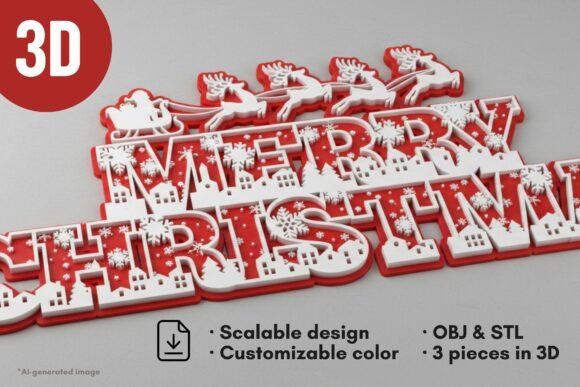
This evolution is particularly evident in projects like the festive 3D Merry Christmas sign, a design that balances aesthetic appeal with practical assembly. The model is engineered for efficiency, featuring three separate pieces: a background, front lettering, and a sleigh. Each component is provided in both STL and OBJ formats, ensuring compatibility with a wide range of slicing software and printers. This modular approach not only simplifies the printing process by reducing the need for complex supports but also allows for creative flexibility in color choices and material selection.
The Shift Toward Digital Craftsmanship
Modern consumers and creators are increasingly valuing uniqueness over mass production. There is a growing desire for items that tell a story or reflect personal taste, rather than generic decorations found in big-box retailers. This trend aligns perfectly with the capabilities of desktop 3D printing. When you download a file for a Merry Christmas 3D Print, you are not just acquiring an object; you are gaining the ability to iterate, modify, and perfect the final product.
For professionals and hobbyists alike, this shift reduces waste and increases satisfaction. Instead of discarding imperfect store-bought items, users can adjust print settings to achieve the desired finish. The recommended dimensions for this specific sign—25 cm × 9 cm for the back piece, 25 cm × 6.1 cm for the front piece, and 12.3 cm × 2.6 cm for the sleigh—offer a substantial presence suitable for mantels, shelves, or entryway tables. However, the true power lies in scalability. Users can easily scale the model to fit smaller spaces or create a grand centerpiece, adapting the design to their specific environmental needs without compromising structural integrity.
Practical Workflow and Assembly Insights
Understanding the workflow is crucial for achieving a professional result. The design’s separation into three distinct parts is a deliberate choice to optimize print quality. Printing flat components like the background and lettering minimizes the risk of warping and eliminates the need for excessive support structures, which can leave marks on visible surfaces. The sleigh, being a smaller, more detailed element, benefits from being printed separately to ensure fine details are captured accurately.
- Material Selection: PLA is often recommended for its ease of use and vibrant color options, but PETG can offer greater durability if the sign will be handled frequently or stored for multiple seasons.
- Orientation: Ensure the back and front pieces are laid flat on the build plate. This maximizes surface adhesion and creates a smooth top layer that requires minimal post-processing.
- Assembly: After printing, simply glue the pieces together. Using a strong cyanoacrylate adhesive or epoxy ensures a lasting bond. Align the front lettering carefully over the background before the adhesive sets to maintain symmetry.
This straightforward assembly process makes the project accessible even to those with limited crafting experience. It transforms a technical printing task into a satisfying hands-on activity, bridging the gap between digital fabrication and traditional craft.
Customization and Creative Freedom
One of the most compelling aspects of using digital files for holiday decor is the potential for customization. While the default design provides a classic look, users can experiment with multi-color prints by changing filaments during specific layers. For instance, printing the sleigh in a metallic gold or silver filament while keeping the lettering in traditional red or green can add a touch of elegance. Alternatively, using translucent filaments for the background and adding LED lights behind the sign can create a glowing effect, enhancing its visual impact during evening gatherings.
For educators and parents, this project serves as an excellent introduction to STEM concepts. Children can learn about spatial reasoning, measurement, and material properties by helping to scale the model or choose colors. It demonstrates how digital designs translate into physical objects, fostering an early appreciation for technology and engineering. Similarly, for small business owners or marketers, offering customized 3D printed decor can be a unique selling point, allowing clients to request specific sizes or color combinations that match their brand or home aesthetic.
Technical Considerations and Best Practices
While the design is ready to print, success depends on proper printer calibration. It is essential to remember that printing settings, including supports, orientation, and materials, must be adjusted by the user according to their specific machine. No two printers behave exactly alike, and factors such as bed leveling, nozzle temperature, and cooling fan speed play critical roles in the final outcome.
Designers provide these files with the expectation that users will apply their knowledge of their own equipment. The disclaimer associated with such models is standard practice: the designer is not responsible for individual printing results. This emphasizes the importance of personal testing and iteration. Start with a small test print of the sleigh to verify detail resolution before committing to the larger background pieces. This cautious approach saves time and material, ensuring that the final assembly meets your expectations.
Sustainability and Long-Term Value
In an era where sustainability is a key concern, 3D printing offers a compelling alternative to disposable holiday decor. Traditional plastic decorations often end up in landfills after a few seasons due to breakage or changing trends. In contrast, a 3D printed sign made from durable materials can be repaired, repainted, or even recycled. If a piece breaks, it can be reprinted individually rather than replacing the entire item. This modularity extends the lifespan of the decoration, reducing overall waste.
Furthermore, the digital nature of the product means there is no physical shipping involved until the user decides to print it. This reduces the carbon footprint associated with logistics and packaging. For those who do not own a printer, local maker spaces or online printing services can produce the item, still often resulting in a lower environmental impact compared to mass-produced imports.
Integrating Tech into Tradition
The integration of technology into holiday traditions does not diminish their warmth; rather, it enhances the personal connection to the items we display. A Merry Christmas 3D Print sign is more than just plastic; it is a testament to the creator’s effort, skill, and attention to detail. It reflects a modern approach to celebration, where convenience and customization coexist.
As we look toward future holidays, the line between digital design and physical decor will continue to blur. We can expect to see more intricate designs, smarter materials, and easier-to-use software that makes 3D printing even more accessible. For now, projects like this festive sign serve as a perfect entry point. They offer a tangible reward for learning new skills and provide a unique decorative element that stands out in a sea of generic ornaments.
Whether you are a seasoned maker looking for a quick yet impressive project, or a newcomer eager to explore the possibilities of additive manufacturing, this design offers a balanced blend of simplicity and sophistication. By downloading the STL and OBJ files, adjusting the scale to your preference, and taking care in assembly, you create more than just a sign. You create a memory, a conversation piece, and a symbol of how tradition can thrive in the digital age.